

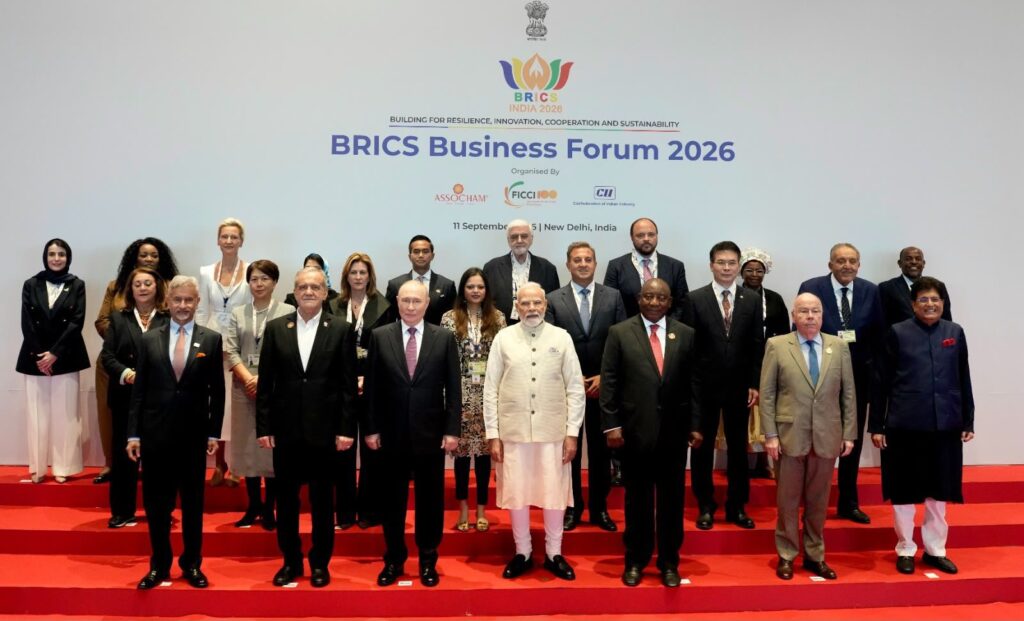
The 18th BRICS Summit in New Delhi has emerged as a defining moment for India-Gulf relations, convening at a time when regional tensions have placed energy security and safe passage through the Strait of Hormuz at the centre of global attention. With India holding the BRICS presidency for 2026, the induction of Saudi Arabia and the UAE into the expanded bloc has reinforced its clout in global energy and finance, casting India as a natural bridge between the Gulf and the broader BRICS community.
The push for closer ties gathered pace in February 2026, when India and the Gulf Cooperation Council formally opened negotiations on a comprehensive free trade agreement spanning Bahrain, Kuwait, Oman, Qatar, Saudi Arabia and the UAE. Those talks build on India’s existing Comprehensive Economic Partnership Agreement with the UAE and a separate pact concluded with Oman in December 2025, weaving years of bilateral progress into a wider regional architecture designed to bolster trade stability, investment flows and job creation.
Prime Minister Narendra Modi’s visit to the UAE in May 2026 lifted the partnership another notch, deepening cooperation on crude oil, LNG and LPG and sealing a strategic agreement to expand Emirati participation in India’s strategic petroleum reserves. The relationship has since travelled well beyond hydrocarbons, branching into clean technology, food security and digital innovation. Gulf capital and renewable expertise are converging with India’s engineering base and market scale across solar equipment, green hydrogen, battery storage and low-carbon technology, while sovereign wealth funds from the region continue to bankroll Indian startups, digital platforms and infrastructure. Indian companies and professionals, meanwhile, are powering Gulf ambitions in artificial intelligence, fintech, cybersecurity, healthcare, space and smart cities.
Regional stability sits at the heart of the emerging agenda. In June, Modi and UAE President Sheikh Mohamed bin Zayed Al Nahyan reaffirmed the importance of safe and unimpeded navigation through the Strait of Hormuz. India’s strategic autonomy, paired with its constructive relationships across West Asia, lends it credibility as a voice for dialogue, diplomacy and de-escalation. As the New Delhi summit plays out, it underscores just how far the India-Gulf partnership has evolved, from a relationship anchored in oil and expatriate labour to one that now spans trade, strategic reserves, green energy, digital transformation, food security and investment.