

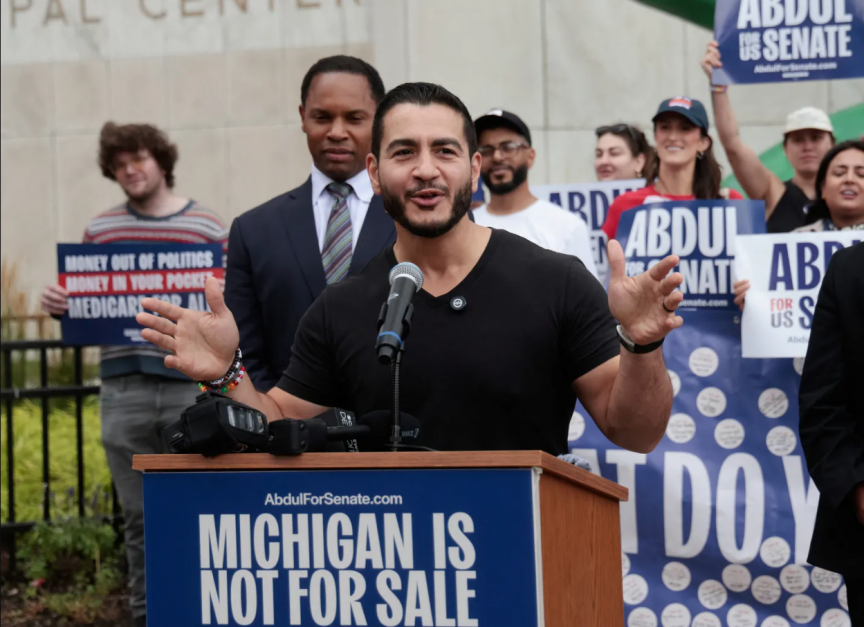
Former public health official Abdul El-Sayed, 41, has won Michigan’s Democratic Senate primary by a very narrow margin.
In one of the most expensive and heated primary contests heading into the US midterm elections, El-Sayed defeated Representative Haley Stevens. Israel and healthcare emerged as the dominant issues between the two candidates.
The Decision Desk called the race with El-Sayed at 48.52 percent and Stevens at 47.47 percent.
Stevens entered the race backed by $62 million in outside advertising. That included $31.9 million from the United Democracy Project, a super PAC affiliated with AIPAC.
The race became more than a Senate contest. For Democrats still reeling from their 2024 defeat, it served as a test of whether the party needs to shift further left to reconnect with disaffected voters, or whether that path leads to defeat in the general election.
Holding the Michigan seat in November is critical for Democrats. El-Sayed will now face former Congressman Mike Rogers, who easily won the Republican primary.
Israel was the most prominent issue in the race. El-Sayed refused to soften his stance and accused his Democratic rival Stevens of supporting continued US military aid to Israel. He also sharply criticized Stevens’s ties to AIPAC. In the closing days of the race, Stevens’s ads suggested El-Sayed was antisemitic.
Despite AIPAC spending roughly $32 million to back Stevens, turnout topped 1.5 million — the highest recorded for a non-presidential Democratic primary in Michigan since 1998.
Throughout the race, El-Sayed openly criticized Israel and foregrounded his Muslim identity. Michigan is home to one of the largest Arab-American communities in the US, concentrated in districts around the Detroit area.
While Stevens drew support from party leaders including Senate Democratic Leader Chuck Schumer and Governor Gretchen Whitmer, El-Sayed campaigned alongside the party’s left flank, including Senator Bernie Sanders and Representative Alexandria Ocasio-Cortez.
In his victory speech, El-Sayed struck a note of unity. “One nation having the right to self-determination is not a reason to strip another nation of that right. None of us are free until all of us are free,” he said.
Michigan-born and of Egyptian descent, El-Sayed is now close to a historic milestone. If he defeats Rogers in November, he will become the first Muslim elected to the US Senate.
For many Muslim Americans, the result carries deeper meaning. “Many Muslim Americans see this as an encouraging moment for political representation. It shows that candidates can be judged on their ideas rather than their religion,” Hamtramck resident Layla Yusuf Al-Hassan told TRT World.
For progressives, El-Sayed’s win was a signal that Democratic voters are ready for candidates who directly challenge the party leadership. For the Democratic establishment, it was a warning that primary voters are drifting away from the voters the party will need in November.
On the coming contest with Republican Rogers, El-Sayed said: “Mike spent 14 years in Congress. The only thing he wanted was a way to make money the day he left Congress… I assure you, in November, we’re going to send him back to Florida.”
Michigan’s answer will come over the next three months.