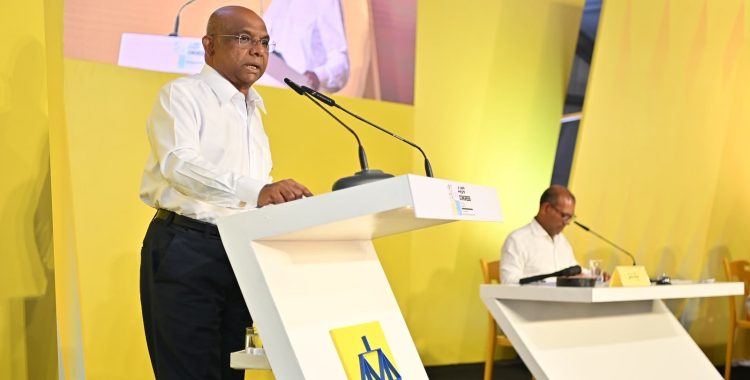


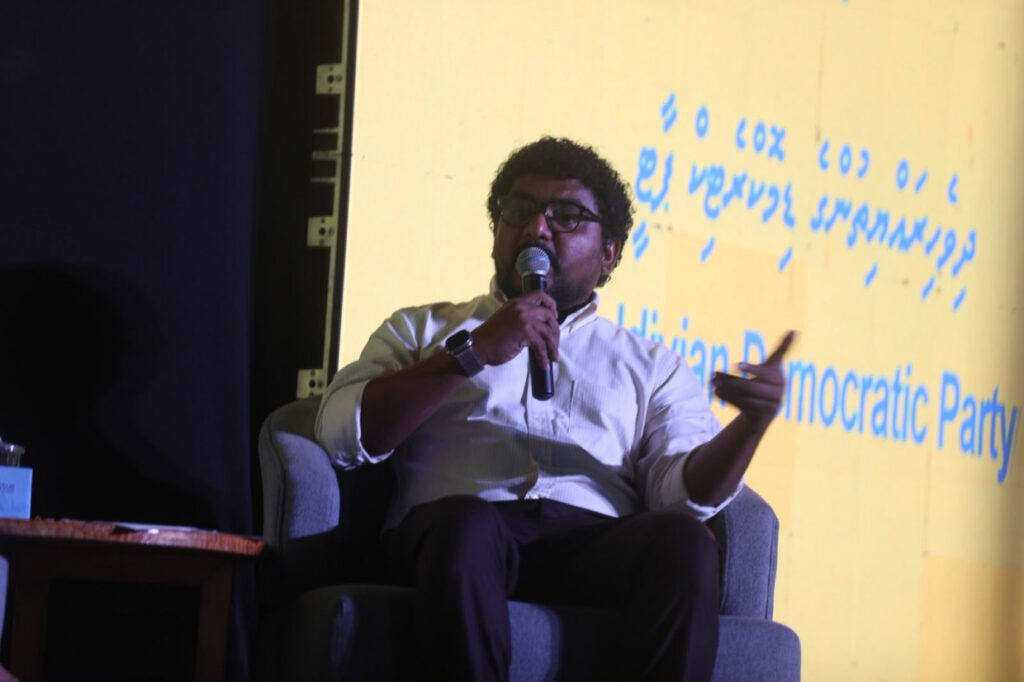
The government has no way to pay salaries even tomorrow to employees of state-owned companies, and that is why employees are being dismissed, Kendhoo constituency MP Maroof Zakir said tonight.
Speaking at a panel discussion titled “Job Thursday” hosted by the opposition MDP, Maroof said that although the government stated after the council elections that political appointees would be removed, that is not what is being seen. Instead, the picture is one of political appointees continuing to be brought in from time to time, he said.
He questioned why the government, through the Privatization and Corporatization Board (PCB) that oversees state-owned companies, is now saying the companies must let staff go.
“What I believe is that you [the government] have paid a loan, paid a sukuk, but there is absolutely no way to pay salaries even tomorrow. After paying salaries, what the government does next is start scrambling for a way to pay salaries for the following month,” Maroof said.
He noted that previous governments had secured grants from foreign countries to run the state, but today the picture is one of foreign assistance drying up.
Maroof pointed out that major international financial institutions such as the International Monetary Fund (IMF) and the World Bank are closely watching how the Maldivian economy is being run and what the government is doing to cut expenditure. He alleged that announcements about reducing staff are likely being issued to make it look as though the government is cutting costs.
He was sharply critical of senior company officials, saying the Managing Directors are operating without any plan and simply following the guidance of President Dr. Mohamed Muizzu.
“The other angle is that because salaries may not be payable, they want to dismiss employees, and in order to find a basis for dismissing them, they are announcing redundancies through the PCB and calling it ‘right-sizing,'” Maroof said.
But that is not a lawful way to make employees redundant, he argued. Employees can only be made redundant when the duties they perform cease to exist, he said. As long as those duties remain, employees cannot be made redundant, and staff must be given advance notice before any redundancy.
He added that employees must be given further opportunities before being made redundant, and that the process for selecting who is made redundant must also be scrutinized.
“As I pointed out earlier, there are two objectives: one is to be seen to be cutting expenditure, and the other is, in truth, to impoverish citizens,” Maroof said.
On 18 April, the Finance Ministry directed that, as part of efforts to reduce operating expenses and tighten expenditure management at state-owned companies, staff numbers should be cut by 33 percent. Then, on Sunday of last week, the Privatization and Corporatization Board ordered that this staff-reduction exercise be completed within three months from that day.
In April, then-Finance Minister Moosa Zameer said the estimated total headcount at government companies stood at around 42,000.
The MDP has previously said that cutting 33 percent of company staff would mean laying off more than 14,000 people, and has estimated that the knock-on effect would touch more than 50,000 people.